
Bozeman Winter Humidity and Your Wood Cabinets | A practical guide to wood movement at 4,820 feet
We're Custom Cabinets Bozeman MT, and we wrote this guide because the most common cabinet complaint in Bozeman is not a broken hinge. It is a hairline crack, a gap at a panel or a door that will not close in February. All of them come from the same cause: low winter humidity, which leaves indoor air very dry. Here is what happens and what to do about it.
Free design consultationTell us about the room. We call back to book a measure.
Why Bozeman air gets so dry indoors
Cold air cannot hold much water. When Bozeman air at 10°F comes into a house through gaps, vents and doors and is heated to 70°F, its relative humidity collapses. Air that felt damp outside can drop to a relative humidity in the teens or low twenties inside. Forced-air heating, wood stoves and tight new houses with lots of fresh-air exchange all make it worse.
Wood responds to that air. It gives up moisture until it reaches balance with its surroundings, a point known as equilibrium moisture content, or EMC. As it loses moisture, it shrinks.
The humidity range wood needs
The Architectural Woodwork Institute sets environmental conditions for fine woodwork in its standards. Relative humidity should average between 25 and 55 percent so that wood stays within roughly 5 to 10 percent moisture content. The AWI also warns that humidity below about 20 percent causes problems such as shrinkage, open joints and checking.
A heated Bozeman house in January can easily sit below that 25 percent floor for weeks. That is the core of the problem.
| Relative humidity | Approximate wood EMC |
|---|---|
| 10% | 2.5% |
| 20% | 4.5% |
| 30% | 6.2% |
| 40% | 7.7% |
| 50% | 9.2% |
| 60% | 11.0% |
The table shows how strongly wood follows humidity. Between a humid summer at 50 percent and a dry winter at 20 percent, wood can move from around 9 percent moisture content down to around 4.5 percent.
How much does wood actually move?
The USDA Forest Products Laboratory Wood Handbook publishes dimensional change coefficients for each species. For flat-sawn white oak, the tangential coefficient is about 0.00365 per 1 percent change in moisture content. That lets us estimate real movement.
Take a 15-inch-wide flat-sawn white oak panel. If its moisture content drops 4 points from summer to winter, it shrinks by roughly 15 × 0.00365 × 4, or about 0.22 inches. That is close to a quarter of an inch across one door panel. Quartersawn wood moves about half as much, and species vary: black cherry and walnut move less than white oak or hard maple.
What goes wrong when wood cannot move
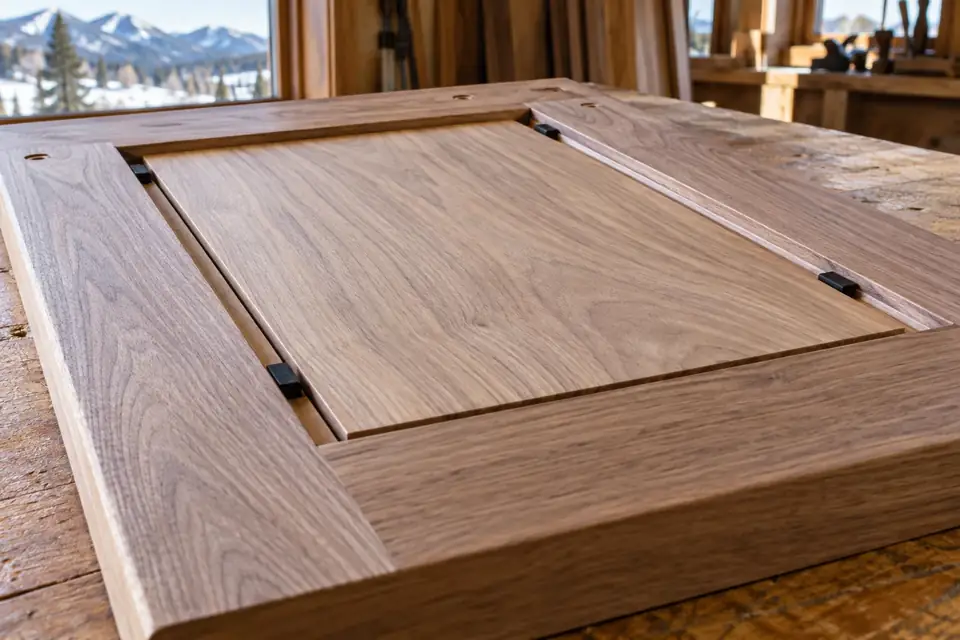
- Cracked centre panels, when a panel is glued tight in its frame and cannot shrink freely.
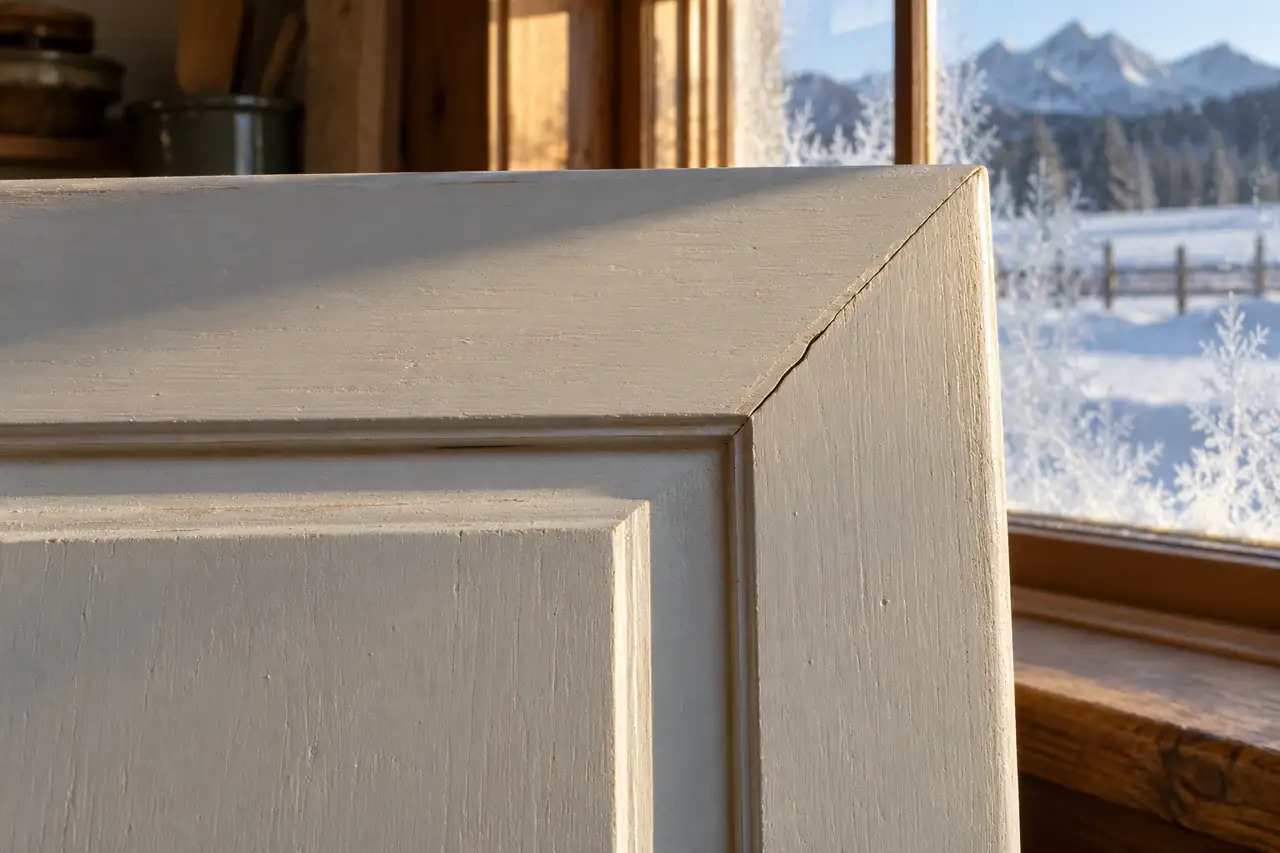
- Hairline cracks in paint at door corners, where frame joints move under a rigid paint film.
- Light lines at panel edges, when a panel shrinks and exposes wood that was hidden in the groove.
- Doors that cup or twist, when one face dries faster than the other.
- Gaps where solid wood meets walls, counters or other parts.
How we build for it
Good construction does not try to stop wood moving. It lets wood move without harm. We float door panels in their grooves with rubber spacers, prefinish panels before assembly so no raw wood shows in winter, use stable plywood boxes, choose MDF panels for painted doors, and finish every face so moisture moves in and out evenly.
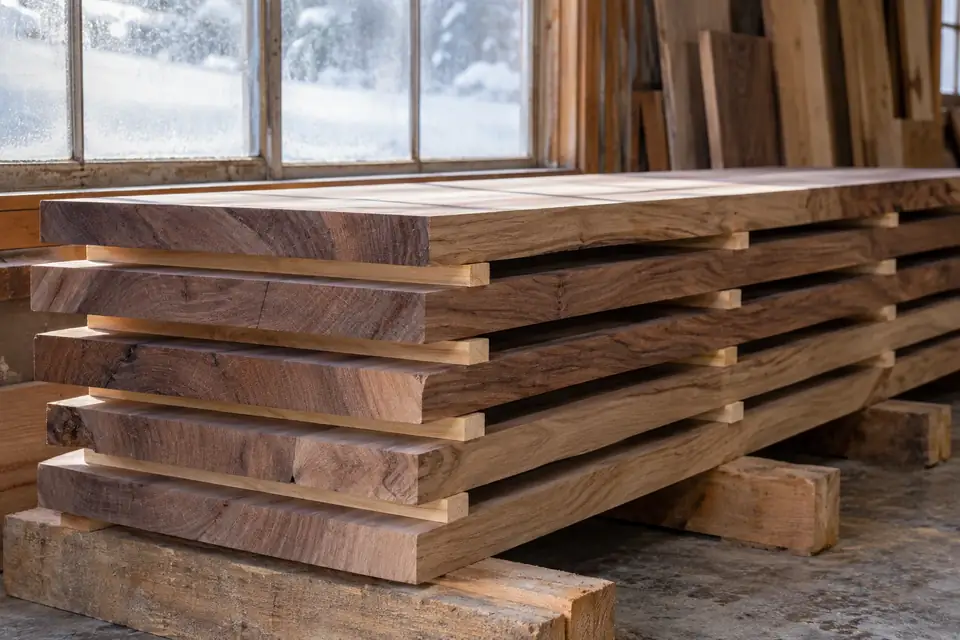
We also acclimate materials. The AWI calls for woodwork to acclimate on site for at least 72 hours at 60 to 90°F with the building operating at its normal conditions. We deliver only once a house is heated and dry.
What homeowners can do
The single most effective step is to raise winter humidity. A whole-house humidifier on the furnace, set to keep indoor humidity toward the AWI range, protects cabinets, floors, instruments and people. Portable humidifiers in main rooms help too. Watch windows: if condensation forms on the glass, humidity is too high for that window, so lower it slightly.
A small digital hygrometer costs little and tells you what is happening. Keep one in the kitchen. If it reads below 25 percent for long stretches, cabinets and floors are drying out.
Winter cracks in paint at door joints are cosmetic and often close as humidity returns in spring. Structural problems such as split panels are rare in well-built doors.
Special cases in the Gallatin Valley
Homes at altitude in Big Sky and West Yellowstone, houses heated with wood stoves, second homes that sit cool and then heat quickly, and log homes that settle all need extra care. The principles are the same: build for movement, keep humidity steady where possible, and avoid sudden swings.
Sources
- Architectural Woodwork Institute, Architectural Woodwork Standards, environmental conditions and acclimation requirements.
- USDA Forest Service, Forest Products Laboratory, Wood Handbook: Wood as an Engineering Material, General Technical Report FPL-GTR-190, chapters 4 and 13.
- U.S. Geological Survey, Geographic Names Information System entry for Bozeman, Montana (elevation).
Winter humidity guide: questions
Follow-up questions on winter humidity and wood movement. For what we build, start at the Custom Cabinets Bozeman MT home page.
What indoor humidity is best for wood cabinets?
The Architectural Woodwork Institute calls for relative humidity averaging 25 to 55 percent, which keeps wood at roughly 5 to 10 percent moisture content. Many Bozeman homes fall below that range in winter without a humidifier.
Why do my cabinet doors crack in winter but look fine in summer?
Wood shrinks as it dries in winter and swells back in summer. Paint films crack at joints as the wood moves, and cracks often close again when humidity returns. Steady humidity reduces the effect.
How much can a wood cabinet panel shrink in a Bozeman winter?
Using USDA Wood Handbook coefficients, a 15-inch flat-sawn white oak panel losing 4 points of moisture content shrinks about 0.22 inches. Quartersawn and more stable species move less.
Should I run a humidifier to protect my cabinets?
Yes, in most Bozeman homes. A whole-house humidifier on the furnace is the most effective option. Watch for condensation on windows and lower the setting if it appears.
What is equilibrium moisture content?
It is the moisture content wood settles at in given air conditions. At 70°F and 30 percent relative humidity, wood settles around 6 percent. At 50 percent, it settles around 9 percent.
How long should new cabinets acclimate before installation?
The AWI calls for at least 72 hours on site at 60 to 90°F with the building at normal operating conditions. We deliver only once the house is heated and dry.
Are painted cabinets more affected by dry air than stained ones?
They show movement more clearly, because paint is less flexible than wood and cracks at joints. MDF panels in painted doors reduce the problem.
Do wood stoves dry out cabinets?
Yes. Stoves dry the air in the room, especially nearby. Keep solid wood away from the stove and add humidity to the room.
Will cracks in painted cabinet joints close up again?
Often, when humidity returns in spring. If they persist, a touch-up after the wood has stabilised usually hides them.
Does adding a whole-house humidifier need a permit in Bozeman?
It can. A furnace-mounted humidifier connects to ductwork, a water supply and often a circuit, which may fall under mechanical, plumbing or electrical permits. Inside Bozeman, ask the city; outside city limits, ask the state Department of Labor and Industry. Portable humidifiers need no permit.