
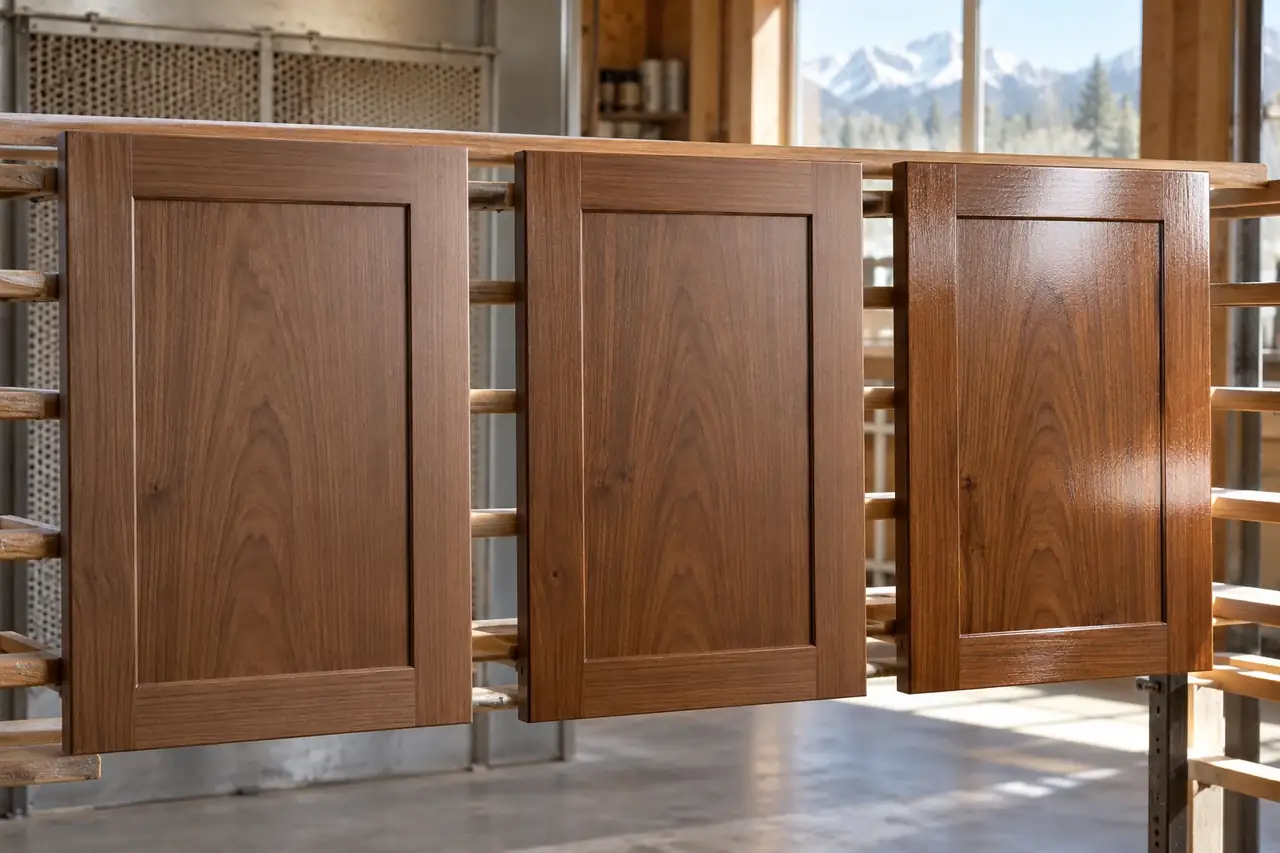
Conversion Varnish vs Lacquer: Choosing a Cabinet Finish | What protects cabinets, and what the data sheets really say
At Custom Cabinets Bozeman MT, we get asked one finish question more than any other: conversion varnish or lacquer? This guide explains the main cabinet finishes, how they differ in durability and repair, how they cope with high-elevation sunlight, and which claims about them you can trust.
Free design consultationTell us about the room. We call back to book a measure.
Why the finish matters
A cabinet finish protects wood from water, heat, grease, cleaning products and wear. In a kitchen, it faces steam from the dishwasher, splashes at the sink and hands on every door. It also controls how quickly moisture moves in and out of the wood, which matters in a dry climate.
The main types of cabinet finish
| Finish | How it cures | Durability | Repair |
|---|---|---|---|
| Nitrocellulose lacquer | Solvent evaporates | Moderate, softer film | Easy, new coats melt into old |
| Pre-catalyzed lacquer | Evaporation plus mild catalyst | Good | Fairly easy |
| Post-catalyzed lacquer | Catalyst added before spraying | Very good | Harder |
| Conversion varnish | Chemical cross-linking with catalyst | Excellent | Hardest, needs scuffing |
| Waterborne coatings | Water evaporates, film forms | Varies widely by product | Varies |
Nitrocellulose lacquer is the traditional furniture finish. It dries fast and repairs easily, but it is softer, less resistant to chemicals and tends to yellow with age. Pre-catalyzed lacquers add a mild catalyst for better durability. Post-catalyzed lacquers and conversion varnishes use a catalyst mixed in just before spraying, which creates a hard, cross-linked film.
What conversion varnish really is
Conversion varnish is a two-part coating that cures by chemical reaction. It is known for high resistance to water, household chemicals and abrasion, which is why many custom cabinet shops use it for kitchens.
Claims about it are often exaggerated. Take Sherwin-Williams Water White Conversion Varnish as an example. Its product data lists about 35 percent solids by volume and 44 percent by weight, includes a UV absorber, and allows force-drying at 110 to 160°F. It is not UV-cured and it is not oven-baked, despite what some marketing says. Its data sheet also sets a maximum dry film thickness, because too much finish can crack.
Always check the product data sheet rather than a sales claim. Solids content, cure method and maximum film build are listed there.
Film thickness and cracking
More finish is not always better. Catalyzed coatings have a maximum recommended dry film thickness, often a few mils in total. Above that, the film can become brittle and crack, especially where wood moves. We apply thin, even coats and stay within the manufacturer limits.
Finishes and mountain sunlight
Ultraviolet light breaks down finishes and changes wood colour. The World Health Organization notes that UV levels rise roughly 10 percent for every 1,000 metres of elevation. Bozeman sits near 1,470 metres, and Big Sky and West Yellowstone are higher still.
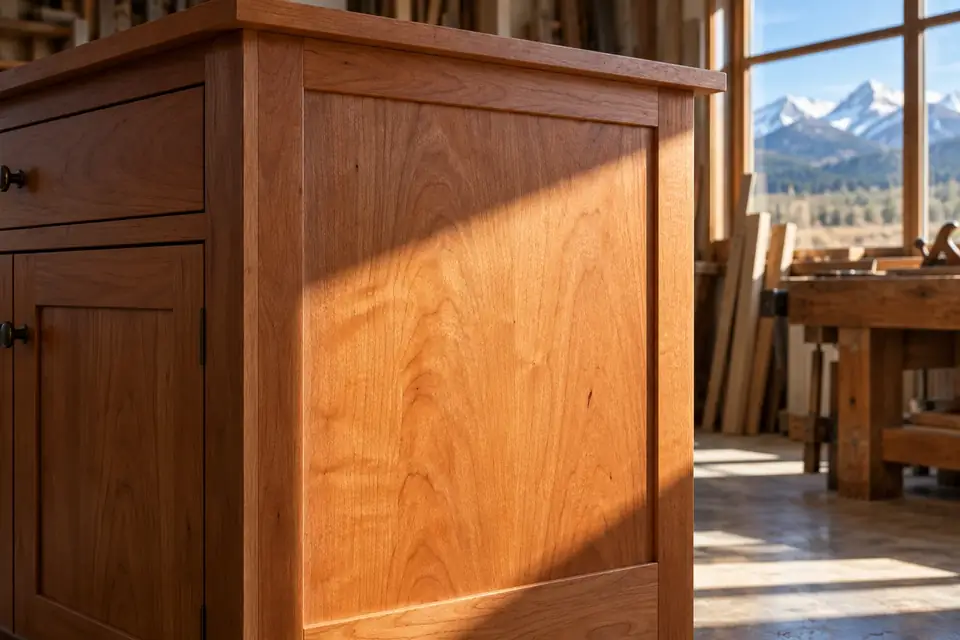
Finishes with UV absorbers slow colour change. Cherry still darkens and walnut still lightens, but more gradually. For cabinets in direct sun, we choose finishes that include UV absorbers and explain how the wood will age.
Testing standards
The Kitchen Cabinet Manufacturers Association performance standard, ANSI/KCMA A161.1, includes finish tests for resistance to common household substances, heat and humidity. Many cabinet coatings state that they are formulated to pass KCMA testing. It is a useful benchmark when comparing products.
How we choose a finish
- Kitchens and baths: catalyzed coatings for water and chemical resistance.
- Furniture-style built-ins in low-wear rooms: finishes that are easier to repair.
- Painted cabinets: catalyzed primers and paints sprayed in the shop.
- Cabinets in strong sun: finishes with UV absorbers.
Caring for a catalyzed finish
Clean with a soft cloth, mild soap and water. Avoid abrasive pads and strong solvents. Wipe spills promptly near sinks and dishwashers. Small chips can be touched up, and larger damage may need a door resprayed.
Paint versus clear finishes
Painted cabinets use the same families of coating as clear finishes, tinted with pigment. A catalyzed primer and catalyzed paint give a hard, durable painted surface. Clear finishes let the wood show and are usually easier to touch up invisibly, because there is no colour to match. Painted finishes show chips more, since the wood beneath is a different colour, so we supply touch-up with every painted kitchen.
Sheen and how it wears
Sheen describes how much light a finish reflects. Matte and satin finishes hide small scratches and fingerprints, which is why most kitchens use them. Semi-gloss and gloss finishes are easier to wipe but show every flaw in the surface and every mark from daily use. A higher sheen also needs more careful sanding between coats, because any defect under the topcoat stands out in raking light.
Finishing in the shop versus on site
Catalyzed coatings need controlled temperature, clean air and proper ventilation to cure well. A shop spray booth provides that. A kitchen on a winter job site does not, and fumes from solvent-based coatings in an occupied house are unpleasant. That is why we finish doors, drawer fronts and most cabinet parts in the shop, and limit site work to small touch-ups and refinishing projects where boxes must be sprayed in place under careful masking and ventilation.
Sources
- Sherwin-Williams, Water White Conversion Varnish product data sheet (solids, UV absorber, force-dry temperatures, film build).
- World Health Organization, Global Solar UV Index: A Practical Guide (UV increase with altitude).
- Kitchen Cabinet Manufacturers Association, ANSI/KCMA A161.1 performance and construction standard for kitchen and vanity cabinets.
- Architectural Woodwork Institute, Architectural Woodwork Standards, finishing systems section.
Cabinet finishes guide: questions
Follow-up questions on cabinet finishes. For what we build, start at the Custom Cabinets Bozeman MT home page.
Is conversion varnish better than lacquer for kitchen cabinets?
For durability, usually yes. Conversion varnish cures to a hard, cross-linked film with strong resistance to water and chemicals. Lacquers are easier to repair but less resistant.
Is conversion varnish UV-cured or oven-baked?
Typical conversion varnishes cure by chemical reaction with a catalyst. Sherwin-Williams Water White Conversion Varnish, for example, can be force-dried at 110 to 160°F but is not UV-cured or oven-baked.
What does solids content mean in a finish?
It is the share of the coating that remains as film after solvents evaporate. Sherwin-Williams Water White Conversion Varnish lists about 35 percent solids by volume.
Can too much finish crack?
Yes. Catalyzed coatings have a maximum dry film thickness. Exceeding it makes the film brittle and prone to cracking.
Do cabinet finishes protect against sun fading?
Finishes with UV absorbers slow colour change but do not stop it. At high elevation, UV is stronger, so it matters more.
Why does nitrocellulose lacquer yellow?
Nitrocellulose ambers as it ages and is exposed to light. That warmth can suit some woods but is unwelcome on white paint.
Are waterborne cabinet finishes durable?
Some are very durable, others less so. Performance varies widely by product, so check the data sheet and test results.
What is the KCMA finish test?
ANSI/KCMA A161.1 is the cabinet industry performance standard, including tests for resistance to household substances, heat and humidity.
How do I repair a chip in a catalyzed finish?
Small chips can be touched up with matching material. Larger damage may need the surface scuffed and resprayed, which is best done in a shop.
Are there permit or air-quality rules for spraying cabinet finishes on site?
No building permit covers refinishing, but spraying solvent coatings indoors creates fumes and fire risk, so good ventilation and no ignition sources are essential. In homes built before 1978, the EPA lead-safe rule applies if old paint is sanded. Spraying doors in a shop avoids most of these issues.